DGAI's First Minutes: Why Liquidity Matters More Than the Headline Price
SnipeRadar detected the listing roughly 70 hours early, assigned Radar Score 70 and displayed Liquidity Risk. The opening charts show why that warning mattered.
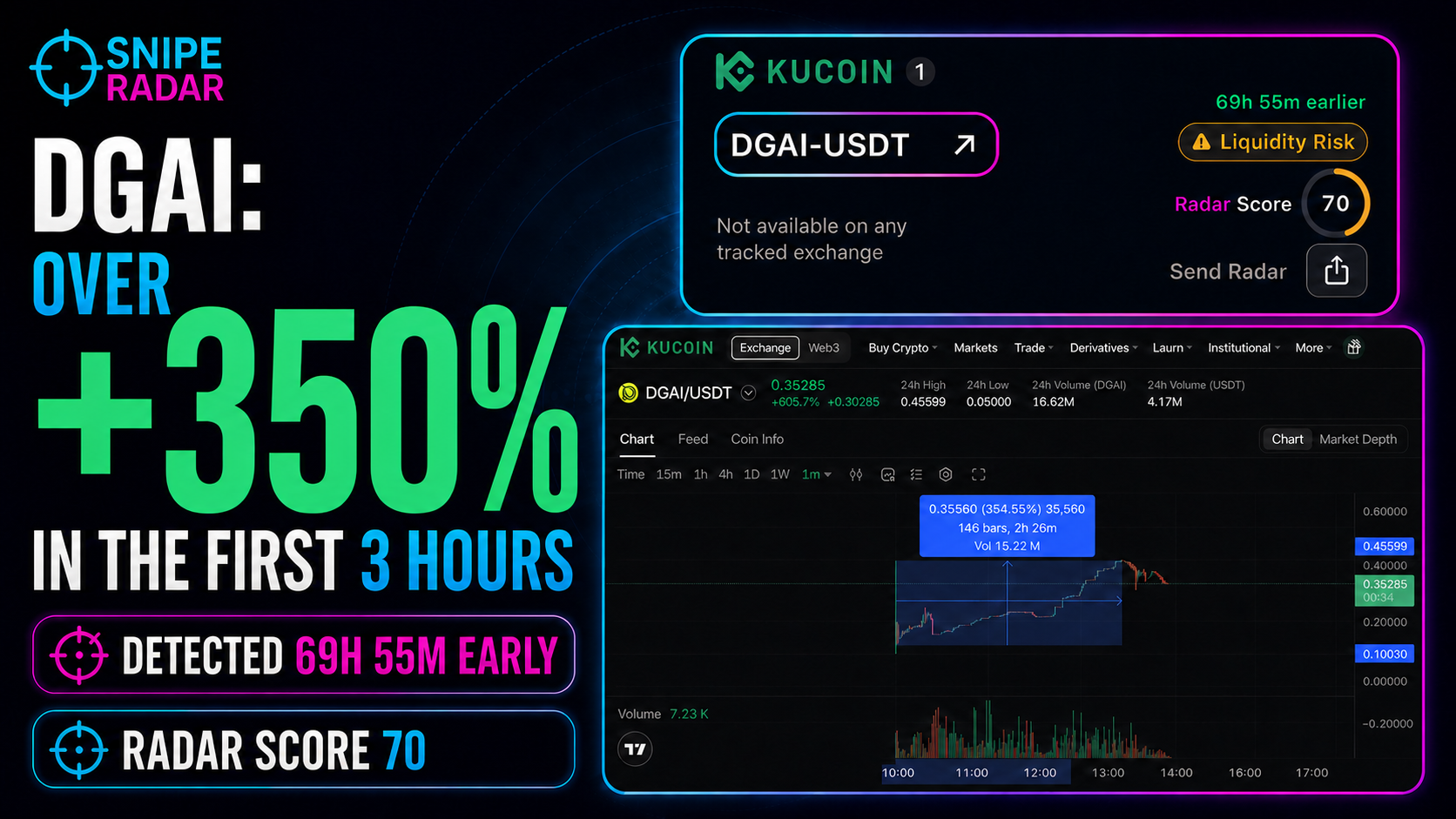
A new token can appear to have a single market price, but the opening of DGAI/USDT showed something very different. On August 24, 2026, the same asset began trading across KuCoin, Gate.io and Bitget with dramatically different first-minute price paths. The contrast is a practical lesson in liquidity, order-book depth and execution risk.
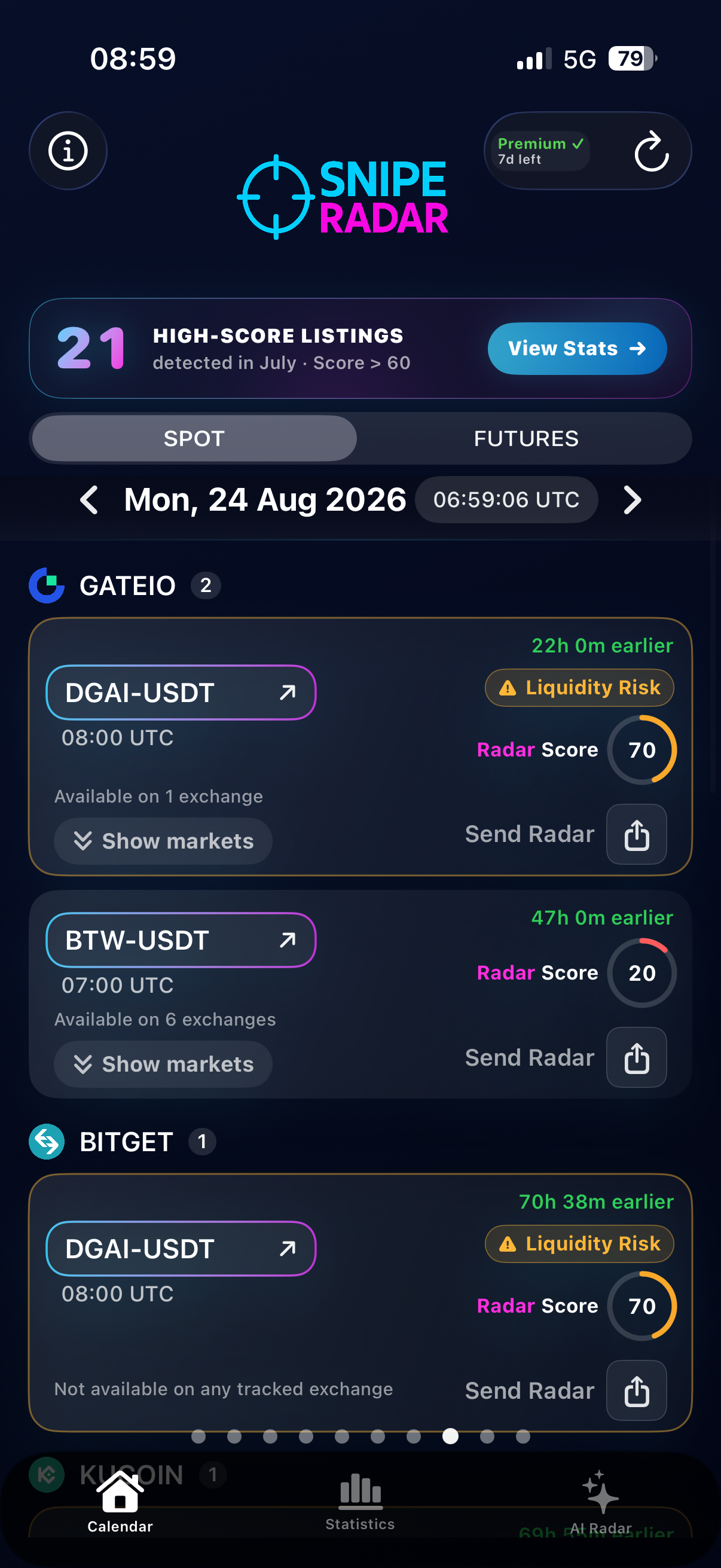
SnipeRadar detected the DGAI listings tens of hours before trading began. The KuCoin signal appeared 69 hours and 55 minutes early, while the Bitget signal was detected 70 hours and 38 minutes early. The event received a Radar Score of 70 together with a Liquidity Risk warning.
What is DGrid AI?
DGrid AI describes itself as a decentralized smart network for AI. Its ecosystem is designed to connect users, developers, model providers and AI agents through a unified marketplace and routing layer, with the aim of making access to AI models more open, verifiable and cost-efficient.
According to the project's official documentation, DGrid includes a gateway to multiple AI models, a marketplace for models and agents, and a decentralized inference network. DGAI is presented as the ecosystem's native utility token for value exchange, incentives and governance.
KuCoin's official listing announcement scheduled a call auction from 07:00 to 08:00 UTC and the start of DGAI/USDT spot trading at 08:00 UTC. KuCoin also launched a 44,000 USDT listing campaign.
Why the first minute is so dangerous
For a newly listed asset, the first minute is often the most fragile and least forgiving moment to buy. It is not an absolute rule, but it is a sensible default risk assumption: the order book may still be thin, fragmented and changing by the second while demand arrives all at once.
A market buy order prioritizes speed, not price. It asks the venue to fill immediately against the best offers currently available. If only a small quantity is offered near the displayed price, the remaining part of the order can move upward through several levels of the book. The result is price impact, while the difference between the expected and actual execution is commonly called slippage.
The general execution principle is well established: in a fast-moving market, a quote represents only a specific available quantity and the final execution can differ materially from the price visible on screen. The SEC's investor guidance on trade execution explains this mechanism in traditional markets; the risk is especially relevant when a newly listed crypto pair has very limited depth.
Automated trading can amplify the effect. A bot configured only to buy as quickly as possible may submit an aggressive order without a sufficiently strict maximum price. Several bots and manual market buyers arriving together can sweep a shallow book in seconds. The screenshots do not identify who placed the DGAI orders, so this is a market-structure explanation, not a claim about specific participants.
One token, three very different openings
| Exchange | Observed chart behavior | Main risk or result |
|---|---|---|
| Bitget | Opening wick near $3.00, followed by an observed decline of about 95% within 20 minutes | Extreme opening dislocation and severe execution risk near the top |
| Gate.io | Opening wick above $2.00, followed by an observed decline of about 95% within 18 minutes | A headline high that did not represent a stable market price |
| KuCoin | Observed move from roughly $0.10 to about $0.45, a chart range above 367% in 2h 24m | More orderly price discovery and the strongest usable observed range |
Bitget: an extreme first-minute dislocation
Bitget displayed the most dramatic opening in the supplied material. The first-minute wick reached close to $3.00 before the chart moved back toward the later trading area. The supplied measurement shows a decline of approximately 95.38% over 20 minutes.
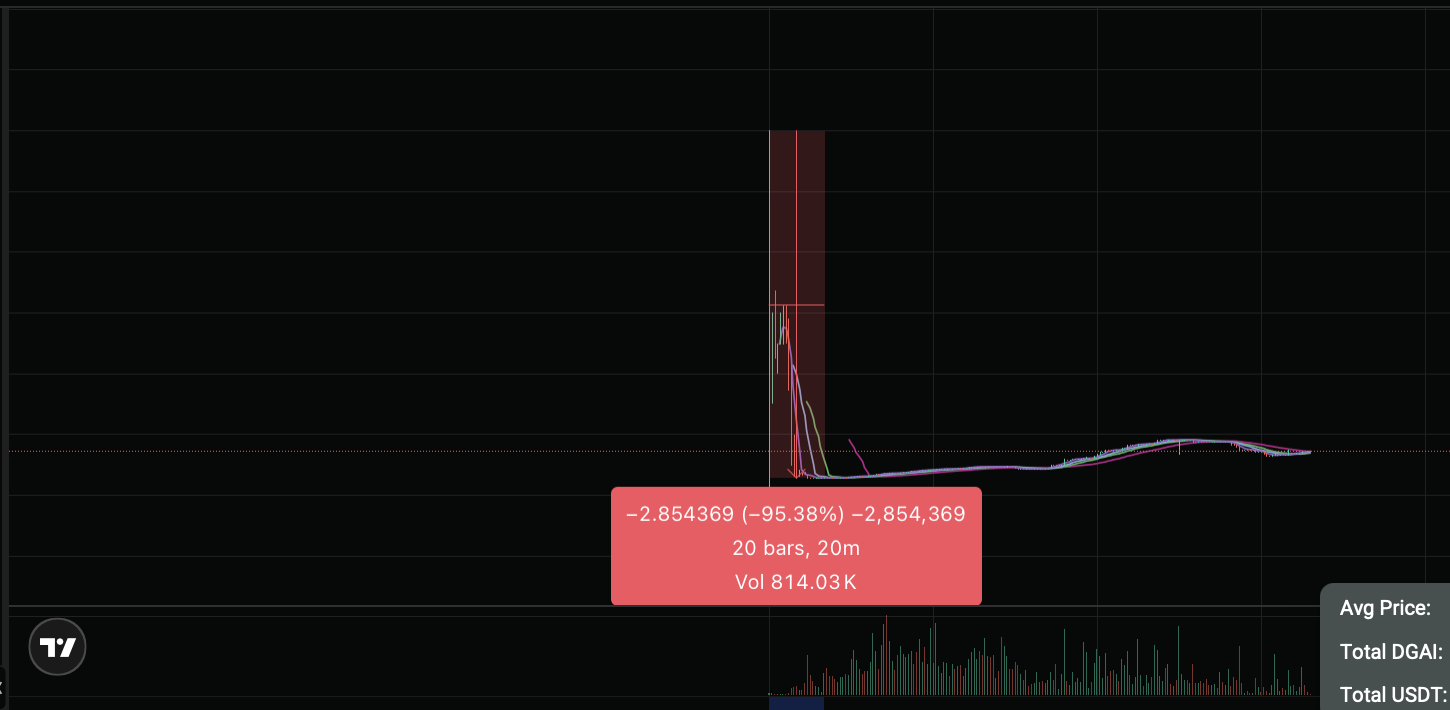
A trader using an unrestricted market order near the top of such a move could receive an execution far above the price visible only moments later. This is exactly why a large percentage shown in an exchange header does not necessarily describe a realistic or repeatable opportunity.
Gate.io: a similar warning in a different market
Gate.io showed a remarkably similar structure. Its opening wick moved above $2.00 before the pair returned rapidly toward a much lower trading area. The supplied measurement shows a decline of approximately 94.96% over 18 minutes.
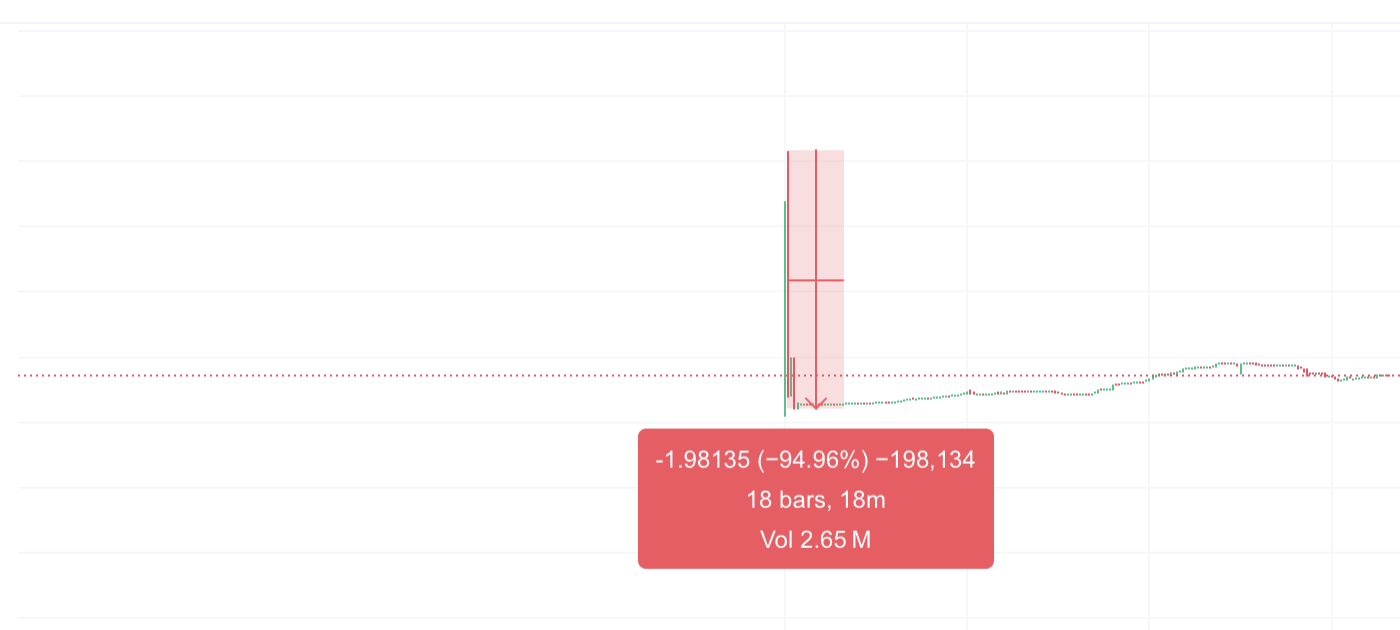
Two separate exchanges producing similarly unstable opening candles reinforces the central lesson: a newly listed token does not begin with one global order book. Each venue has its own inventory, market makers, spreads, queue and incoming order flow. The token is the same; the available liquidity is not.
KuCoin: the most orderly opening in this comparison
Among the three supplied charts, KuCoin offered the most coherent and usable opening path. DGAI still moved rapidly, but the chart did not show the same multi-dollar first-minute dislocation followed by an immediate collapse of roughly 95%.
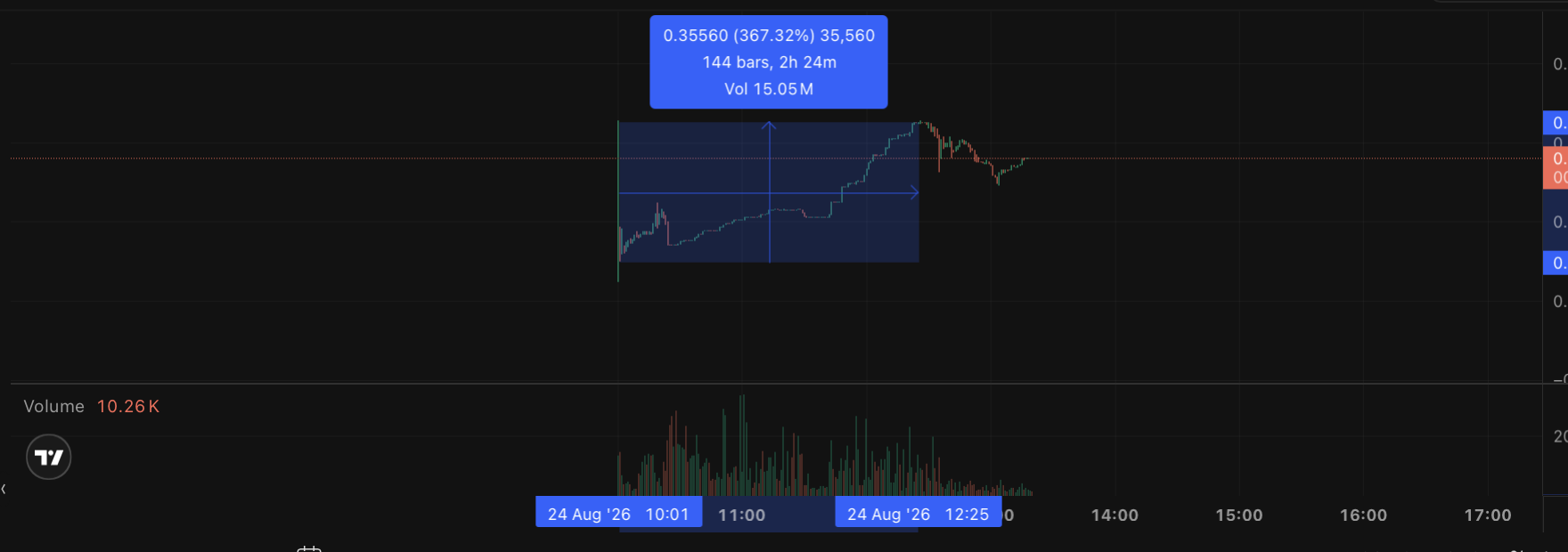
That behavior is consistent with a better-balanced opening book and stronger usable liquidity around the starting range. KuCoin's scheduled one-hour call auction may also have helped collect orders before continuous trading began. A chart alone cannot prove the exact depth supplied by each venue or identify every cause, but the difference in the observed result is substantial.
Credit is due to KuCoin for the comparatively orderly DGAI opening shown in this case. For users, available liquidity is not an abstract statistic: it can determine whether a buy order is filled near the expected price or far above it. The relevant question is not only whether an exchange lists an asset, but whether the pair has enough real depth when trading starts.
What the SnipeRadar signals meant
Radar Score 70 did not promise a profitable trade, and Liquidity Risk did not predict that DGAI had to fall. The two signals served different purposes. Radar Score organized the available pre-listing information into a research priority, while Liquidity Risk warned that execution conditions could be unstable enough to dominate the outcome.
The first-minute behavior on Gate.io and Bitget later demonstrated why that warning was relevant. KuCoin, meanwhile, showed that the same token could still produce a very different and more orderly market when the available liquidity and opening process were different.
This is how SnipeRadar is intended to support research: detect the event early, organize the available signals and highlight material risks. The final decision—and responsibility for it—always remains with the user.
A practical checklist before buying a new listing
- Compare venues. The same token can open at very different prices on different exchanges.
- Inspect the order book. Look beyond the last traded price and check the spread and depth on both sides.
- Treat market orders carefully. In a thin book, speed can come at an unexpectedly high price.
- Do not confuse a wick with available liquidity. A chart high may represent only a very small executed quantity.
- Allow price discovery to develop. Waiting through the most chaotic opening seconds can reveal a more stable trading range.
- Use SnipeRadar as a research tool. Radar Score and Liquidity Risk are inputs for further analysis, not trading instructions.