SWARM on KuCoin, MEXC and Bitget: One Token, Three Markets
SWARM/USDT opened on three exchanges at 10:00 UTC on August 19, 2026. The token was the same; liquidity, execution and price discovery were not.
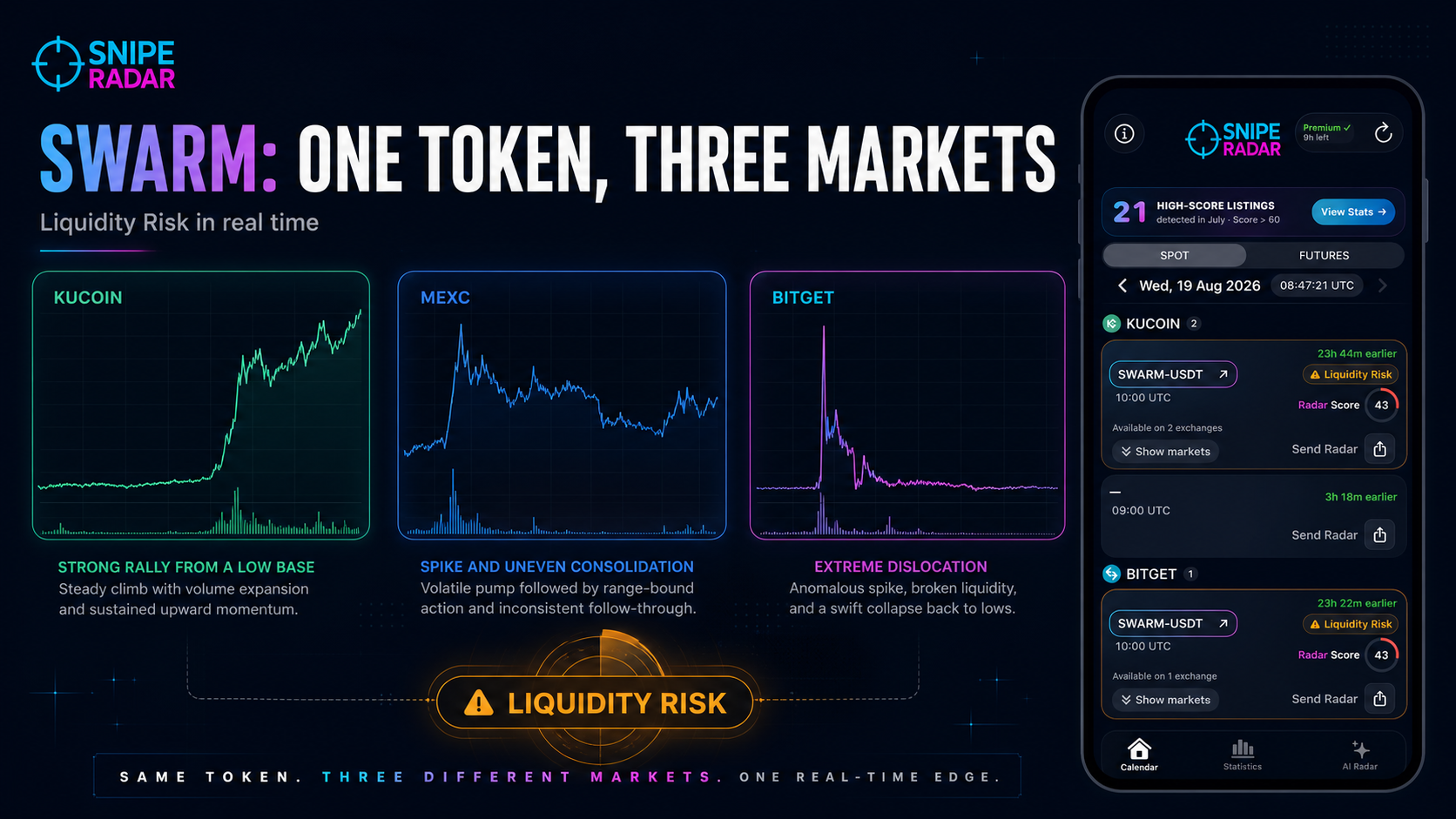
At 10:00 UTC on August 19, 2026, SWARM/USDT opened for spot trading on KuCoin, MEXC and Bitget. On paper, this looked like one event: the same token, the same quote currency and the same opening time. In practice, it became three separate experiments in liquidity and price discovery.
Readers who want to research the project behind the ticker can visit the SwarmBase project website.
SnipeRadar detected the listing roughly 23 hours before trading opened. The event received a Radar Score of 43 together with a Liquidity Risk warning. What happened next is a useful example of why those two signals answer different questions.
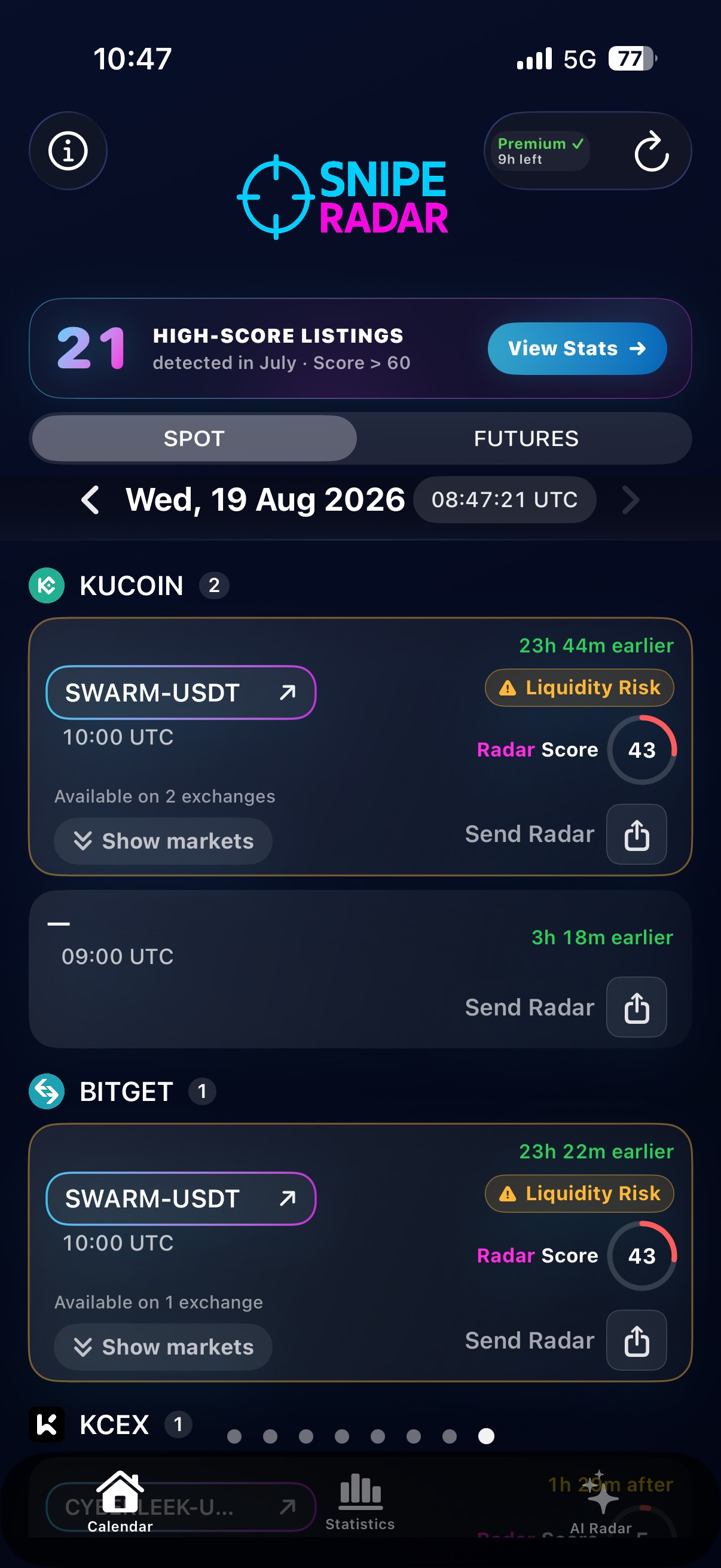
One listing time did not create one market
The official exchange announcements placed SWARM/USDT trading at 10:00 UTC on August 19. The schedules can be checked in the KuCoin listing announcement, the MEXC listing announcement and the Bitget listing announcement.
Matching schedules do not connect order books. Every exchange starts with its own inventory, market makers, spreads, order flow, platform rules and technical conditions. That is why the visible price of a newly listed asset may differ dramatically from the price at which a real order can be executed.
| Exchange | Observed price path | Approx. low-to-high range | Main issue |
|---|---|---|---|
| KuCoin | About $0.0227 to $0.18 | About +694% | Fast rally, but comparatively coherent price discovery |
| MEXC | About $0.134 to $0.43 | About +222% | High volatility and an uneven opening range |
| Bitget | Extreme dislocation versus the other venues | Not meaningfully comparable | Buy-side access was unavailable during our observation |
KuCoin: the cleanest observed opportunity
Among the three supplied market snapshots, KuCoin produced the most coherent price path. The observed price area began near $0.0227 and the move extended to approximately $0.18. Using those endpoints, the maximum chart range was roughly 694%.
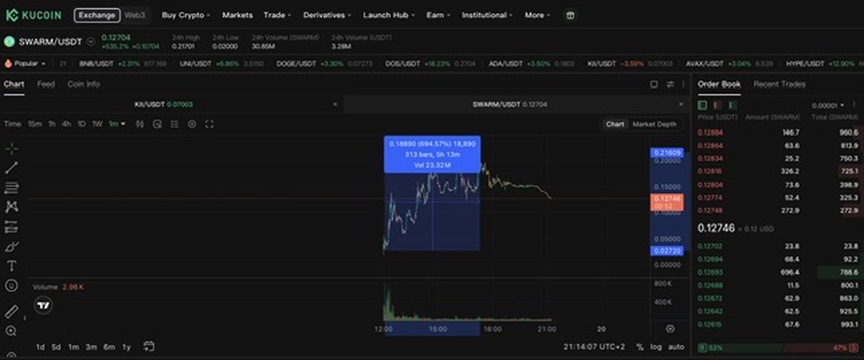
This does not mean every trader could have bought the low and sold the high. It means that, with hindsight, KuCoin showed the widest usable low-to-high range in the material we reviewed without the same degree of market dislocation visible on Bitget. Timing, queue position, spread and available depth still determined actual execution.
MEXC: a large move from a much higher starting point
MEXC also recorded a sharp and unstable opening. The chart reached approximately $0.43, but the realistic observed starting area was closer to $0.134 than to zero. That distinction matters: a move from about $0.134 to $0.43 is approximately 222%, not a return calculated from the bottom of the chart canvas or from a brief, non-executable wick.
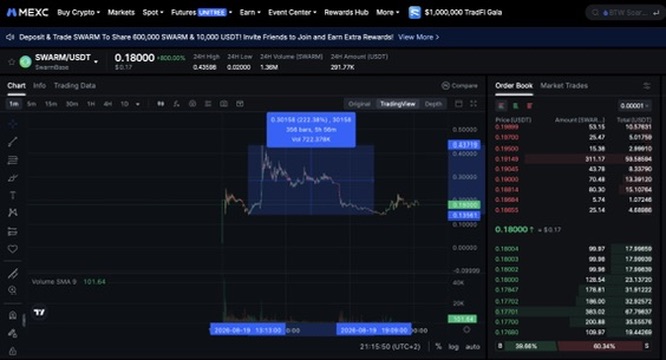
The market still offered a substantial range, but its structure was less attractive than the headline high alone might suggest. A chart can show an impressive peak while the order book tells a more complicated story about what could actually be bought and sold.
Bitget: when the displayed price stops being the whole story
Bitget behaved differently from both KuCoin and MEXC. During our live observation, buy-side access was unavailable while the displayed SWARM price moved far away from the other exchanges. The supplied screenshot shows an extreme opening spike followed by a rapid collapse and a reference price still measured in dollars while the other venues were trading in cents.
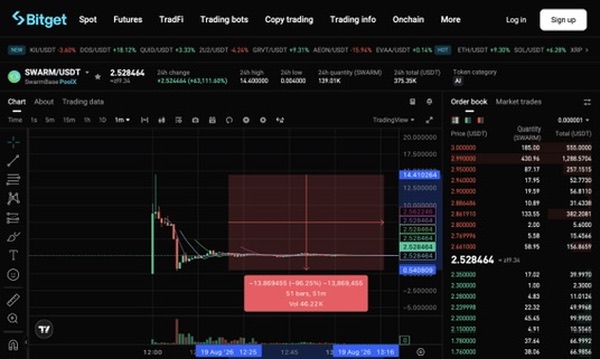
We have not found a public Bitget notice that independently documents this temporary buy-side restriction. We therefore treat it as a contemporaneous observation from the trading interface, not as a quoted statement from the exchange. Even with that limitation, the episode demonstrates the central point: a displayed price is not useful if market access, depth or two-sided execution is impaired.
That is precisely the type of environment the Liquidity Risk label is designed to flag. It does not predict whether the first candle will be green or red. It warns that the market may be fragile enough for spread, slippage, limited depth or execution constraints to dominate the outcome.
Why Radar Score 43 was not a failure
Radar Score is not an oracle and it is not a forecast of the highest percentage candle after listing. A low score does not mean that a token cannot rally. A high score does not guarantee a profitable trade.
The score is a research filter. It weighs the signals available before the event and helps users decide how much additional scrutiny a listing deserves. In this case, a score of 43 kept the event in a cautious category. The later KuCoin rally does not invalidate that assessment; it shows why realised price action and pre-listing risk evaluation are different measurements.
Liquidity Risk delivered the more directly relevant signal for this specific launch. It warned, before trading began, that execution conditions could be unstable. Bitget then produced the clearest example of that danger, while MEXC showed a milder version through volatile and uneven price discovery.
The practical lesson: compare markets, not just tokens
The SWARM launch produced four useful lessons:
- The same ticker does not create the same market. Each exchange has an independent order book and independent execution conditions.
- A chart high is not the same as an executable return. The relevant range starts at a price where an order could plausibly fill and ends at a price where liquidity was available.
- Radar Score and Liquidity Risk have different jobs. One prioritises research; the other highlights fragile market structure.
- Access matters as much as direction. A rising displayed price can still represent a dangerous market if users cannot reliably buy, sell or transfer the asset.
For SnipeRadar, this was not a story about perfectly predicting a candle. It was a demonstration of why early detection must be paired with execution-risk context. The alert created time for research. Radar Score encouraged caution. Liquidity Risk identified the part of the event that ultimately mattered most.